





How Game Developers Are Using Generative AI
 By Deepak SehrawatPublished on Oct 14, 2026
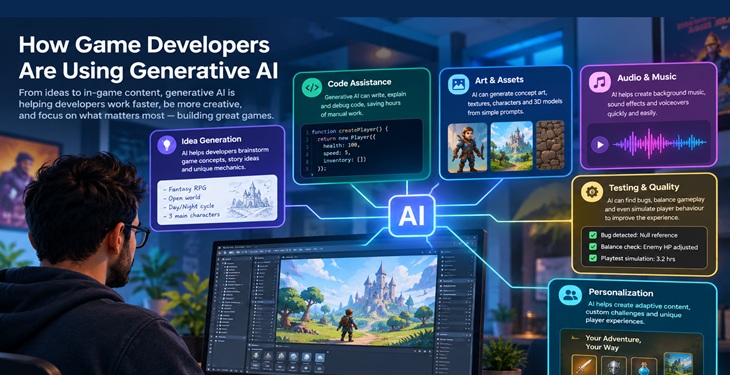
Generative AI is becoming another tool in the game developer’s toolbox. It is not replacing the whole development process, but it is helping teams handle tasks that can take hours or even days. Developers are using it for ideas, code, dialogue, artwork, testing and other parts of production.
The change is also happening inside familiar game-development software. Current Unity AI tools, for example, can work inside the editor and help with project-aware development and asset creation.
AI Is Speeding Up Early Game Ideas:
The first stage of a game can involve a lot of brainstorming. Developers may need ideas for characters, missions, locations, enemies or gameplay mechanics before production even begins.
Generative AI can help turn a rough idea into a starting point.
For example, a developer working on a fantasy game could ask for:
Character concepts
Quest ideas
Enemy variations
Level themes
Dialogue prompts
Gameplay mechanics
The important part is that these suggestions still need human judgement. A generated idea may be useful, but it does not automatically fit the game's story or mechanics.
Game Art Is Another Major Use:
Creating game assets can take considerable time. Generative AI can help developers produce early concepts for characters, environments, textures and other visual elements.
Unity has previously highlighted AI tools that can generate 2D assets, textures and even 3D-related content.
This can be particularly useful during prototyping. Instead of waiting for every finished asset, a team can create temporary visuals, test the level and replace them later.
That makes the process more flexible.
NPCs Can Become More Interactive:
Traditional NPCs usually follow dialogue trees or predefined behaviours. Generative AI opens another possibility: characters that can respond more naturally to player actions.
AI-powered NPC systems are already available for game-development platforms. Unity's ecosystem, for example, includes tools designed to give characters conversational abilities and more flexible interactions.
This could make an NPC feel less like a character with five fixed replies and more like someone reacting to what is happening in the game.
There is still a catch. Developers need to control what an AI character can say and do, especially in multiplayer games and games aimed at younger audiences.
Writing and Dialogue Can Be Faster:
Dialogue is another area where generative AI can save time.
A developer can use an AI model to create a rough conversation, rewrite a line in a different tone or produce several versions of the same response. Tools integrated with Unity are already being used for AI-assisted dialogue generation and localization workflows.
That does not mean writers become unnecessary. In practice, the generated material often needs editing to match the game's characters, humour, story and overall tone.
AI Can Help with Coding:
Programming is another practical use.
Developers can ask AI tools to explain an error, suggest a code structure or create a starting point for a small feature. This can be useful for repetitive tasks and prototypes.
For an experienced developer, the value may be less about getting an entire system written and more about reducing the time spent on small jobs.
A developer still needs to test the code. AI-generated code can contain mistakes, inefficient approaches or security problems.
Testing Can Also Benefit:
Game testing involves finding crashes, broken mechanics, unusual player behaviour and other problems.
AI-assisted testing can help automate parts of this work. Unity has highlighted automated QA tools that allow AI bots to explore levels and report issues such as errors and crashes.
This does not remove the need for human testers. Players do things that automated systems may not anticipate, and subjective issues such as whether a level feels boring are difficult to measure.
Personalised Games Could Be the Next Step:
One of the more interesting possibilities is games that react to individual players.
Generative AI could help adjust:
Dialogue
Missions
Enemy behaviour
Difficulty
Character interactions
World events
The idea is not simply to generate more content. It is to make the content feel more relevant to the player.
Unity has discussed the possibility of AI-driven systems that respond to player behaviour and dynamically adjust gameplay.
Where Developers Still Need to Be Careful?
Generative AI is useful, but it brings practical concerns.
Developers still need to check:
Whether generated content fits the game's style
Copyright and licensing issues
Accuracy of generated code
Privacy and data handling
Quality of AI-generated dialogue
Performance and server costs
Safety of AI-powered interactions
The industry's attitude is also not simply “use AI everywhere.” A 2025 GDC report found that more than 30% of game developers surveyed were using generative AI tools at work, while also noting concerns about using the technology as an assistance tool rather than replacing creative roles.
Generative AI Is More of an Assistant Than a Replacement:
The most practical way to look at generative AI in game development is as a production assistant.
It can handle first drafts, repetitive work and quick experiments. Developers and artists can then spend more time on decisions that shape the actual game.
That distinction matters. A game is not just a collection of assets and lines of code. Game feel, pacing, balance, art direction and storytelling still require people who understand what makes the experience enjoyable.
The Bigger Change Is in the Workflow:
Generative AI is changing game development less by creating a finished game with one command and more by shortening the distance between an idea and a working prototype.
A designer can test more ideas. A programmer can work through repetitive tasks faster. Artists can explore more concepts, while writers can experiment with dialogue and story branches.
The technology still has limits, and human review remains important. But as AI becomes more closely connected with game engines and development tools, its role is likely to become a normal part of the workflow rather than a separate experiment.
Frequently Asked Questions (FAQs)
How is generative AI used in game development?
It can assist with game ideas, dialogue, coding, artwork, NPC behaviour, asset creation and automated testing.
Can AI create an entire game?
AI can help generate many individual parts, but a complete, polished game still requires planning, development, testing, editing and human decision-making.
Can AI create game characters?
Yes. AI tools can assist with character concepts, dialogue, voices, visuals and behaviour. Some current tools also support conversational NPCs.
Will generative AI replace game developers?
It is more realistic to view AI as a tool that changes how developers work. Current industry reporting shows adoption alongside concerns about relying on it as a replacement for creative roles.